How Seed Remedies Maintains Purity in Every Bottle

In the world of edible oils, purity isn’t just a promise, it’s the foundation of trust and health benefits that customers rely on. At Seed Remedies, every bottle of our cold-pressed groundnut, coconut, castor, and sesame oils undergoes a meticulous process to ensure unadulterated quality from seed to shelf. This commitment to purity sets us apart in a market often clouded by refined alternatives, delivering oils that retain their natural nutrients, flavors, and therapeutic properties.

The Essence of Cold-Pressed Purity

Cold-pressing is the cornerstone of our purity protocol, a traditional method that extracts oil without heat or chemicals, preserving the seed’s inherent goodness. Unlike solvent-extracted oils, which use hexane and high temperatures that strip away antioxidants and essential fatty acids, our process gently crushes seeds at temperatures below 50°C to yield pure, nutrient-dense oil. This technique ensures that vitamins, minerals, and bioactive compounds like vitamin E in sesame oil or lauric acid in coconut oil remain intact, offering superior health benefits for cooking, skincare, and wellness.

For Seed Remedies, cold-pressing isn’t a gimmick; it’s a deliberate choice rooted in sustainability and efficacy. Groundnut oil, for instance, emerges with its rich monounsaturated fats preserved, ideal for heart-healthy Indian cuisines, while castor oil retains its ricinoleic acid for natural laxative and anti-inflammatory uses. By avoiding refinement steps like bleaching or deodorizing, we eliminate the risk of introducing contaminants, resulting in oils that taste authentic and provide maximum bioavailability. This purity translates to longer shelf life without preservatives and a cleaner burn point for frying, aligning with modern health-conscious consumers seeking toxin-free options.

Sourcing Seeds: The First Line of Defense

Sourcing Seeds

Purity begins in the fields, where we partner exclusively with certified organic farmers across India to source premium seeds free from pesticides and GMOs. Our rigorous selection criteria include visual inspections for damage, mold, or discoloration, alongside lab tests for moisture content (ideally 8-10% to prevent rancidity) and foreign matter like stones or debris. For groundnut seeds, we prioritize varieties with high oleic acid content from regions like Gujarat, ensuring resilience against oxidation, while coconut kernels come from Kerala plantations known for their virgin quality.

This upstream control is vital because subpar seeds can compromise the entire batch. We reject shipments exceeding 1% impurity levels, opting instead for those verified through third-party certifications like FSSAI and USDA Organic. Sesame seeds, sourced from Tamil Nadu, undergo aflatoxin testing to stay below 10 ppb, safeguarding against mycotoxins that could affect liver health. By tracing every lot via blockchain-enabled records, Seed Remedies guarantees transparency, customers can scan a QR code on the bottle to view the seed’s journey, fostering accountability in an industry prone to adulteration.

Cleaning and Preparation: Removing Impurities

Once at our facility, seeds enter a state-of-the-art cleaning line designed to eliminate contaminants without compromising integrity. The process starts with pre-cleaning using vibrating screens and magnetic separators to remove 50% of initial impurities like dust, husks, and metal fragments. For coconut and groundnut, we employ air aspiration to separate lighter debris, followed by gravity tables that sort by density, ensuring only pristine kernels proceed.

Dehulling follows for applicable seeds, sesame and groundnut shells are gently cracked and winnowed to isolate the nutrient-rich cores, reducing fiber content that could affect oil yield. Moisture is precisely controlled through solar drying if needed, preventing microbial growth while maintaining enzyme activity for better extraction. Castor seeds receive special attention, with their toxic husks fully removed to yield safe, pure ricinoleic-rich oil suitable for both edible and topical use. Throughout, we monitor parameters like humidity (below 60%) and temperature to avoid oxidation, with inline sensors alerting operators to deviations. This multi-stage cleaning achieves impurity levels under 0.2%, far surpassing industry standards and ensuring the oil’s clarity and safety.

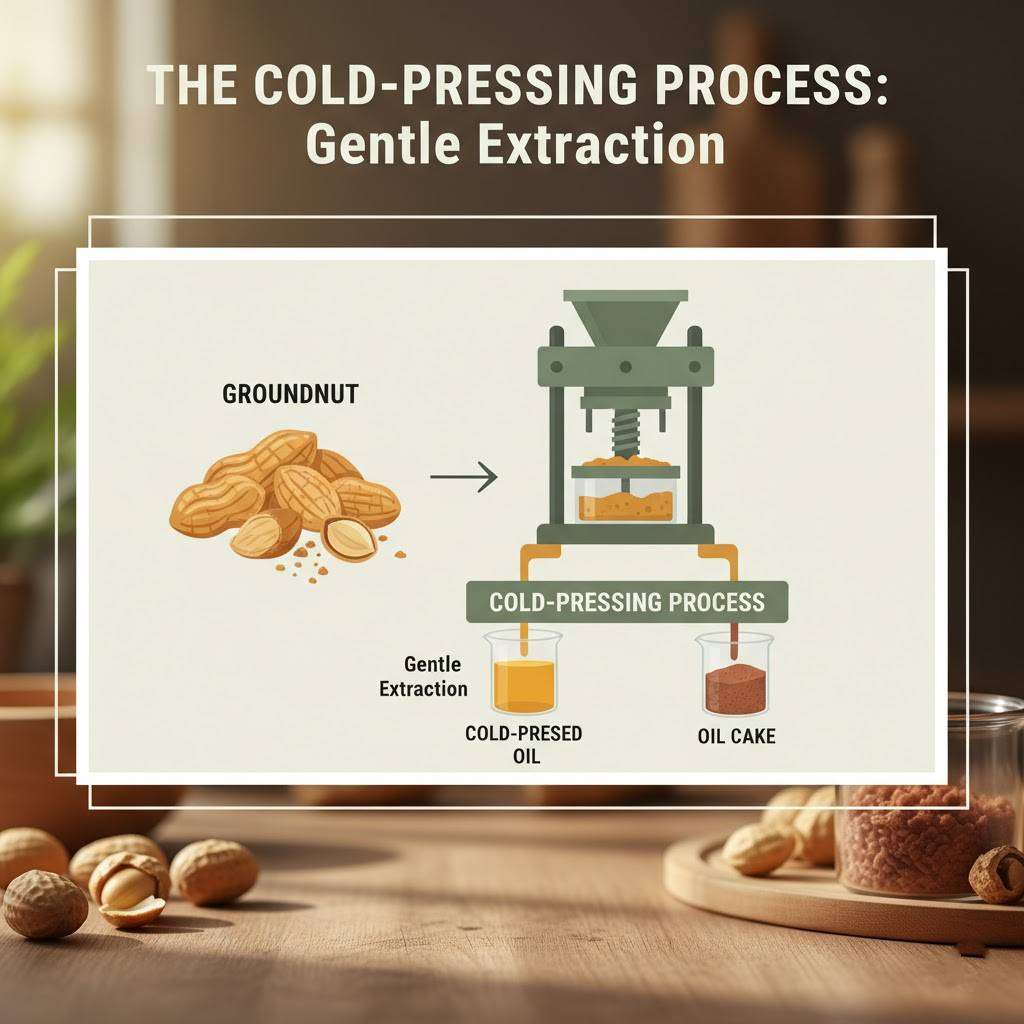
The Cold-Pressing Process: Gentle Extraction

the cold pressed process - gentle extraction

At the heart of our operation is the cold-pressing machinery, wooden ghani-inspired expellers for sesame and groundnut, and hydraulic presses for coconut and castor that mimic ancestral methods with modern precision. Seeds are flaked into thin sheets to optimize surface area, then slowly pressed at low RPMs to extract 30-40% of the oil naturally, leaving behind a nutrient-packed cake for animal feed. No heat is applied, preserving polyphenols in sesame oil that support anti-inflammatory effects and medium-chain triglycerides in coconut oil for quick energy metabolism.

For castor oil, the process is uniquely tailored: seeds are pre-heated minimally to 40°C to facilitate separation without degrading the oil’s therapeutic profile. Yield efficiency is balanced with purity. we accept lower outputs to avoid over-pressing, which could introduce bitter notes or free fatty acids. Post-extraction, the raw oil is immediately settled in stainless-steel tanks to allow natural sedimentation of any residual solids, bypassing chemical filters. This hands-on approach, overseen by trained technicians, ensures each batch reflects the seed’s purity, with groundnut oil emerging golden and nutty, ready for tempering in South Indian dishes.

Filtration and Refinement: Minimal Intervention

True purity means minimal tampering, so our filtration is a gentle, multi-pass affair using micron-rated cloth and activated carbon beds to remove fine particulates without altering the oil’s composition. For sesame oil, we incorporate a light centrifugation step to clarify while retaining its signature aroma from sesamol compounds. Coconut oil, being solid at room temperature, undergoes warm filtration at 35°C to liquify and purify, ensuring a pristine white finish ideal for hair masks or baking.

Castor oil receives vacuum filtration to eliminate air pockets that could lead to spoilage, achieving clarity without solvents. We test for peroxide values (under 5 meq/kg) and acid values (below 2 mg KOH/g) at this stage, rejecting any batch showing early rancidity signs. Unlike mass producers, Seed Remedies skips degumming or neutralization, preserving phospholipids that enhance nutritional value. This results in oils with natural cloud points and flavors, groundnut’s mild nuttiness shines through, perfect for everyday stir-fries, while extending usability up to 18 months when stored properly.

Quality Testing: Rigorous Lab Validation

Every batch undergoes comprehensive lab scrutiny in our on-site facility, accredited to ISO 22000 standards, to verify purity at molecular levels. We conduct organoleptic tests for color, aroma, and taste sesame should evoke a toasty nuttiness, not bitterness alongside chemical assays for free fatty acids (FFA <1%), iodine value (measuring unsaturation), and heavy metals (lead <0.1 ppm). Microbial plating ensures zero pathogens like Salmonella, crucial for edible oils.

Spectroscopy analyzes fatty acid profiles: groundnut oil must show 40-50% oleic acid for stability, while coconut’s 45-52% lauric acid confirms authenticity. For castor, ricinoleic acid exceeds 85%, validating its purity for wellness applications. Adulteration checks via GC-MS detect dilutions with cheaper oils, a common industry issue we combat with 100% traceability. Third-party audits from labs like SGS quarterly validate our claims, ensuring compliance with Codex Alimentarius and Indian food safety norms. These tests not only maintain purity but also build consumer confidence, as results are publicly available on our website.

Packaging and Storage: Preserving Integrity

From lab to bottle, our packaging seals in purity using amber glass or food-grade PET to block UV light, which accelerates oxidation in oils like sesame. Bottles are filled under nitrogen flush to minimize oxygen exposure, with induction sealing for tamper-proof security. Labels detail batch numbers, expiry (12-24 months), and usage tips, empowering customers to store in cool, dark places away from heat sources.

For bulk buyers, we offer 5L tins with similar protections. Our warehouse maintains 15-25°C and 50% humidity, with FIFO inventory to prevent aging. This end-to-end care ensures that when you open a Seed Remedies bottle, the oil pours as pure as the day it was pressed, vibrant, aromatic, and full of life.

Why Purity Matters for Your Health and Kitchen

In an era of processed foods, Seed Remedies’ purity delivers tangible benefits: reduced inflammation from unrefined antioxidants, better digestion via natural enzymes, and versatile use from cooking to cosmetics. Groundnut oil’s high smoke point (160°C) suits deep-frying without harmful acrylamides, while sesame’s lignans support hormonal balance. Coconut oil aids weight management with its MCTs, and castor promotes skin hydration without synthetics. By choosing purity, you’re investing in wellness that aligns with Ayurvedic principles simple, natural, effective.

At Seed Remedies, maintaining purity isn’t optional; it’s our ethos. From ethical sourcing to final seal, every step honors the seed’s potential, delivering bottles that nourish body and soul. Explore our range at seedremedies.com and taste the difference purity makes.

Leave a Reply

Your email address will not be published. Required fields are marked *

Home Shop Deals Cart Account